

With the re-establishment of the Department of Planning and Architecture, Ho Chi Minh City needs a mechanism that ensures the body does more than “draw up plans”: it must also wield the authority and instruments to carry them out. Mr. Dzung Do Nguyen, CEO of enCity, spoke to VnExpress about the implications of reviving the department. Drawing on international experience, he offered proposals to help the city avoid planning that remains on paper, but grounded in real needs and sectoral potential.
enCity is pleased to share the full version of this interview. A shortened version is available on VnExpress.

—
How do you view the decision to revive the Ho Chi Minh City Department of Planning and Architecture?
Mr. Dzung Do Nguyen: The move should be seen from two angles.
First, planning is inherently strategic. Day-to-day regulation and management, which has been the domain of the Department of Construction, demand different skills and absorb most of its time. A complex city such as Ho Chi Minh City needs a dedicated agency to chart its long-term spatial development. Separating planning from construction is therefore logical: it gives the city an anchor for the “big picture.”
But planning is more than drawings. The real, and most difficult, task is to integrate many layers, from land, transport, infrastructure, industry, to environment, into a coherent whole. Planning a financial district, for example, is not just about allocating land uses. It also means thinking through metro connections, road layouts, the links between Long Thành and Tân Sơn Nhất airports, and how to stimulate aviation-linked commerce and industry.
The point, then, is not to revert to the old model, but to equip the new department with fresh thinking and mechanisms that allow it to play its part effectively.
Even before the recent merger, Ho Chi Minh City was Vietnam’s most complicated urban case: the densest population, the most intense economic and social activity, all within a crowded and sprawling geography. Coordination across departments has often fallen short. Having worked on large planning projects here, I saw how agencies tended to assume that planning was solely the remit of the Planning and Architecture Department, yet no single body can fully grasp the opportunities and challenges of every sector.
In places like Singapore, each ministry has its own planning unit. When a master plan is drawn up, they provide inputs: housing, industrial land, office space, road corridors, depots. Put together, their demands typically exceed the city-state’s land many times over. It is the central planning agency’s job to reconcile them, ensuring that society’s needs are met within the constraints of land and finance. Often this involves asking agencies to scale back or stack functions: a flood-control pump underground, a park above; a metro depot below, a shopping centre above; school sports fields that double as community facilities after hours. This mindset informed the latest master plan for Ho Chi Minh City, within the limits of Vietnam’s legal framework.
For Ho Chi Minh City, one of only two jurisdictions (along with Hanoi) to have such a department, it is vital that it become the “conductor” of urban development, with each line department acting as a player in the orchestra.
No one knows better than the Department of Education how many schools will be needed in ten years, or better than Industry and Trade how much industrial land will be required, or better than Health how many hospitals are necessary. Technical and social infrastructure are still planned according to rigid standards. But the gulf between those standards and reality is wide. Standards describe an ideal end state; departments must move step by step toward it, often over decades. Their practical inputs must shape the planning brief. The goal is not compliance with a drawing but enough schools, green space, clean air, and streets free of congestion and flooding.
Re-establishing the Department acknowledges the need for a conductor. But it also requires an orchestra not only of skilled players, but of players able to keep time with one another.
Critics argue that Ho Chi Minh City has sprawled like an oil slick, with overloaded infrastructure, few public spaces and suspended projects: all signs of poor planning. Do you agree?
Mr. Dzung Do Nguyen: That is partly true, but incomplete. Planning has two phases: drafting and execution. What we see today reflects both. Some plans misjudged reality; others were sound but poorly implemented.
Singapore offers a lesson. There, the planning authority also holds tools to carry out its own plans. It does not merely “draw dreams” and wait for others, but auctions land according to zoning objectives and oversees construction. Infrastructure is handled by other agencies. If an area is designated as a financial centre or tourist hub, the authority can auction the land, select developers, and ensure projects fit the plan. Success even brings it a share of the revenues.
This ties “planners” to “implementers.” If a vision is fanciful, investors shun it and the plan gathers dust. If realistic, it attracts capital and becomes a living district.
In Ho Chi Minh City, by contrast, the department depends on a web of others: Construction, Industry and Trade, Finance, Agriculture and Environment. When a plan fails, the tangle of laws, procedures and responsibilities makes it hard to know why.
What tools should the city give the Department to prevent plans from staying on paper?
Mr. Dzung Do Nguyen: First, each department must have its own planning staff and formal channels to coordinate with the Planning and Architecture Department. That ensures plans are grounded in real needs and sectoral potential.
Second, the Department must hold implementation tools and be accountable for results. That avoids the disconnect where one agency makes policy and another executes, leading to impracticality.
As the prime minister once noted, institutions are the biggest bottleneck, but also the easiest to fix, since they are of our own making. Vietnam has just carried out a sweeping administrative overhaul in a matter of months. Few countries could move so fast. With that spirit, the old refrain that “this would be too difficult in Vietnam” should be obsolete. Giving the Department the mandate to deliver is entirely possible.
Singapore again provides an example. Its Housing Development Board (HDB) not only receives land and funds but also manages the building-materials market, keeping housing at four times average income (compared with roughly 30 times in Ho Chi Minh City). With that authority, it has housed 80% of citizens, enabling young couples to buy homes after only a few years of work, with state support.
We should move from process-based management to results-based management: give budgets and goals, but let the agency choose how—whether in-house, with consultants, direct appointment, competitive tender, or hiring global experts at top salaries—so long as outcomes are achieved and no corruption is involved. The outcomes matter: clean air, safe streets, accessible parks, affordable homes, schools and playgrounds.
The problem is not capacity but incentives. Often incentives are absent, misaligned, or perverse. Fix them, and institutions can turn from bottlenecks into enablers.
A further problem lies at the national level. We expect too much from planning, demanding encyclopedic documents that take entire political terms to produce, thus slowing development for lack of “legal cover.” But long and detailed does not mean good. As Hanoi’s former chairman Hoàng Văn Nghiên observed two decades ago: “General plans are too detailed, while detailed plans are too general to be implemented.”
As a planner from Curitiba once put it, their success lay not in “urban planning” but in “urban doing.” Ideas were tested on the ground so citizens benefited immediately, instead of waiting for procedures and drawings. In Vietnam we want to leap into a 4.0 economy, yet remain stuck with 1.0 processes. For breakthroughs, Ho Chi Minh City and the government must break through in planning itself.

Post-merger, Ho Chi Minh City spans nearly 7,000 sq km with 14m people. What opportunities and challenges does this bring?
Mr. Dzung Do Nguyen: Three stand out.
First, the vast geography.
Second, the huge and diverse population of 14m people with very different incomes, lifestyles and needs. Designing spaces where they can live, work and learn is no simple matter.
Third, time. Buildings rise in a year or two; plans take 20–30 years to mature. Infrastructure projects, land acquisition, and land-use changes may take decades. So planning must tackle immediate issues while keeping an eye on the long horizon.
Good planning often looks implausible at first. The plan for Phú Mỹ Hưng, drawn up in the 1990s, seemed far-fetched at the time. Thirty years later it is reality.
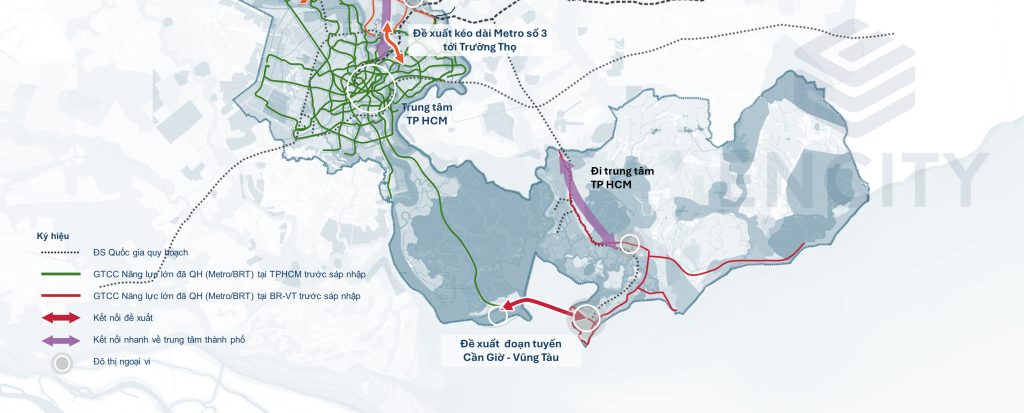
After the merger, challenges are greater still: not only managing the old core but also a vast urban region stretching into Bình Dương and beyond, as well as distant cities like Vũng Tàu and Phú Mỹ.
Yet opportunities are clearer too. The city now has more land, fewer parochial constraints, and more room to optimise resources. In the past, industrial estates were sited in low-lying, flood-prone districts to lure foreign investment. Now those areas can be reserved for eco-urban functions, while industry can move to better-suited land in Bình Dương or Bà Rịa–Vũng Tàu. This allows growth that is both more sustainable and more cost-efficient.
Unified coordination is another advantage. Previously, border disputes such as the polluted Ba Bò canal between Ho Chi Minh City and Bình Dương were hard to resolve. Now, under one administration, industry and environment can be balanced.
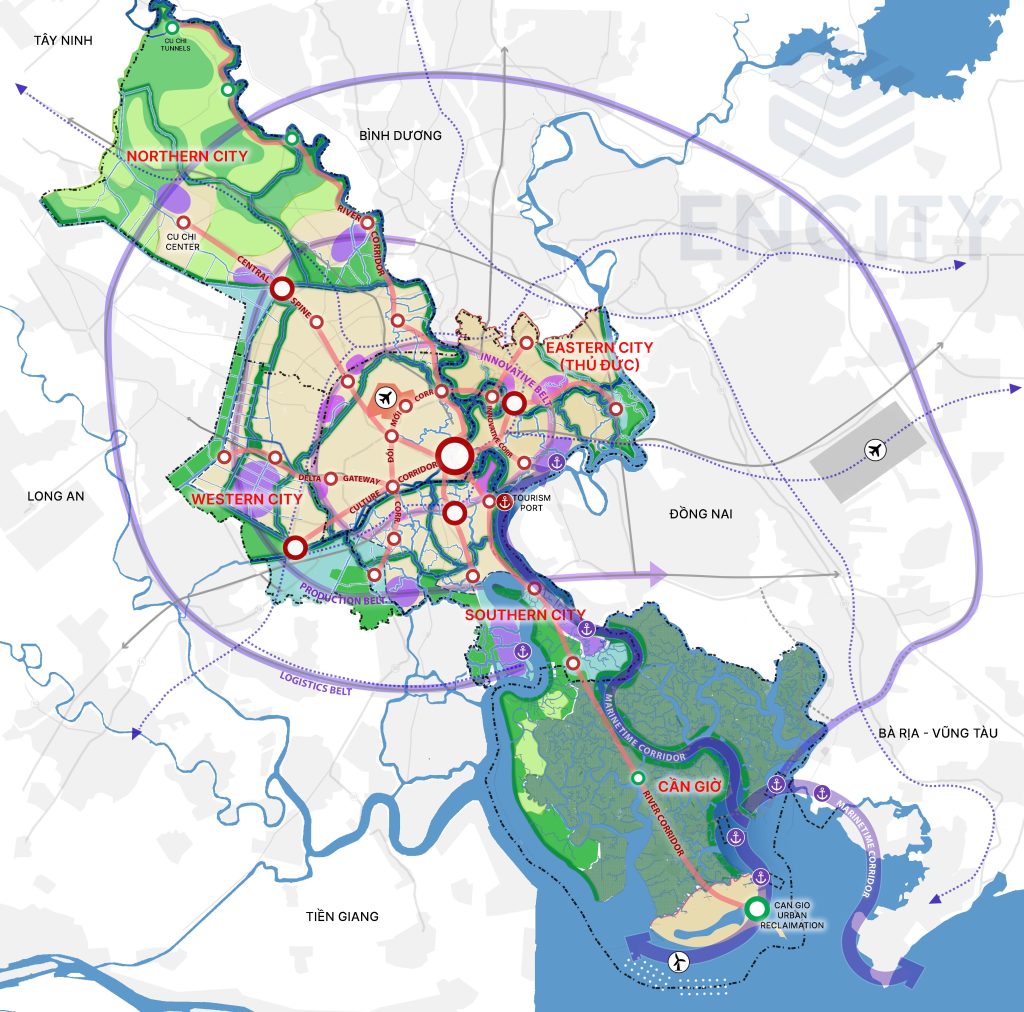
The merger also enables higher-level integration. Rather than cutting a road through mangroves to serve Cần Giờ port, it can be linked via Phú Mỹ to the Cái Mép–Thị Vải complex, connecting it to the Bình Dương–Đồng Nai–Phú Mỹ industrial belt and Long Thành airport via Ring Road 4, without damaging mangroves. Metro Line 2 could be extended beyond Hóc Môn–Củ Chi to Thủ Dầu Một, boosting connectivity both ways. Planning the Sài Gòn River can now cover both banks, for landscapes, water quality and flood control.
In short, the challenge is scale and population. But the opportunity is a mega-city no longer confined by administrative borders, with land and unified authority. Used well, this can yield strong growth and environmental balance, which is the essentials of sustainability.
The city chairman has said he wants a new plan within a year, under a streamlined process, to leave time for execution. What should be prioritised?
Mr. Dzung Do Nguyen: Planning here is too burdensome. Vietnam is almost unique in turning general plans into rigid legal instruments. We expect them to cover everything, which makes them slow to prepare and slow to adjust.
So the first change must be in mindset. No general plan can predict parcel-level details 20–30 years out. General plans should be strategic and flexible. In Singapore, the master plan is not a binding legal document. The Chief Planner interprets, details and adjusts as needed. Vietnam, by contrast, makes the general plan both a vision and a legal technical file. Even bending a road around a heritage building requires lengthy amendments, wasting time and opportunities.
After the merger, Ho Chi Minh City cannot simply stitch together three old plans. It must redefine its structure: which areas for industry, which for ecology, which corridors for transport, where metro lines should run. Patching may save time now, but will squander resources later.
The priority is to create a new planning framework while the formal statutory adjustments take their time. This framework should be strategic, not overly detailed, but should answer key questions: What development model? Where will people and infrastructure shift? The framework should be a century-long vision, allowing rapid but sustainable growth.
This could be entrusted to a task force led by the re-established department, drawing in capable staff from line agencies and supported by experts with both international and domestic experience. Such a model ensures both speed and coordination.
Interview by Lê Tuyết

 VI
VI