

The “Green and Resilient Rural Recovery through Agri-Food System Transformation in the Asia and Pacific Region” project aims to enable increased domestic food production and increase food resiliency in the Maldives. enCity, working together with Agritecture, a leading consultant in urban and controlled environment agriculture, proposed a comprehensive strategy package, including protected farming systems, hydroponic systems and regenerative farming systems. With a particular focus on increasing the participation of women and youth, the project will support nutritious food supply at home, community and commercial levels.
The challenges
The Maldives is facing multi-faceted food system vulnerabilities. Over 70% of households lack access to quality fresh produce, while 95% express safety concerns about imported food. Traditional home gardening has declined dramatically, with only 64% of households maintain gardens compared to historical levels. Furthermore, agriculture holds little appeal for youth, constrained by limited land access, poor market connectivity, and climate vulnerabilities that threaten the nation’s food security.

The approach
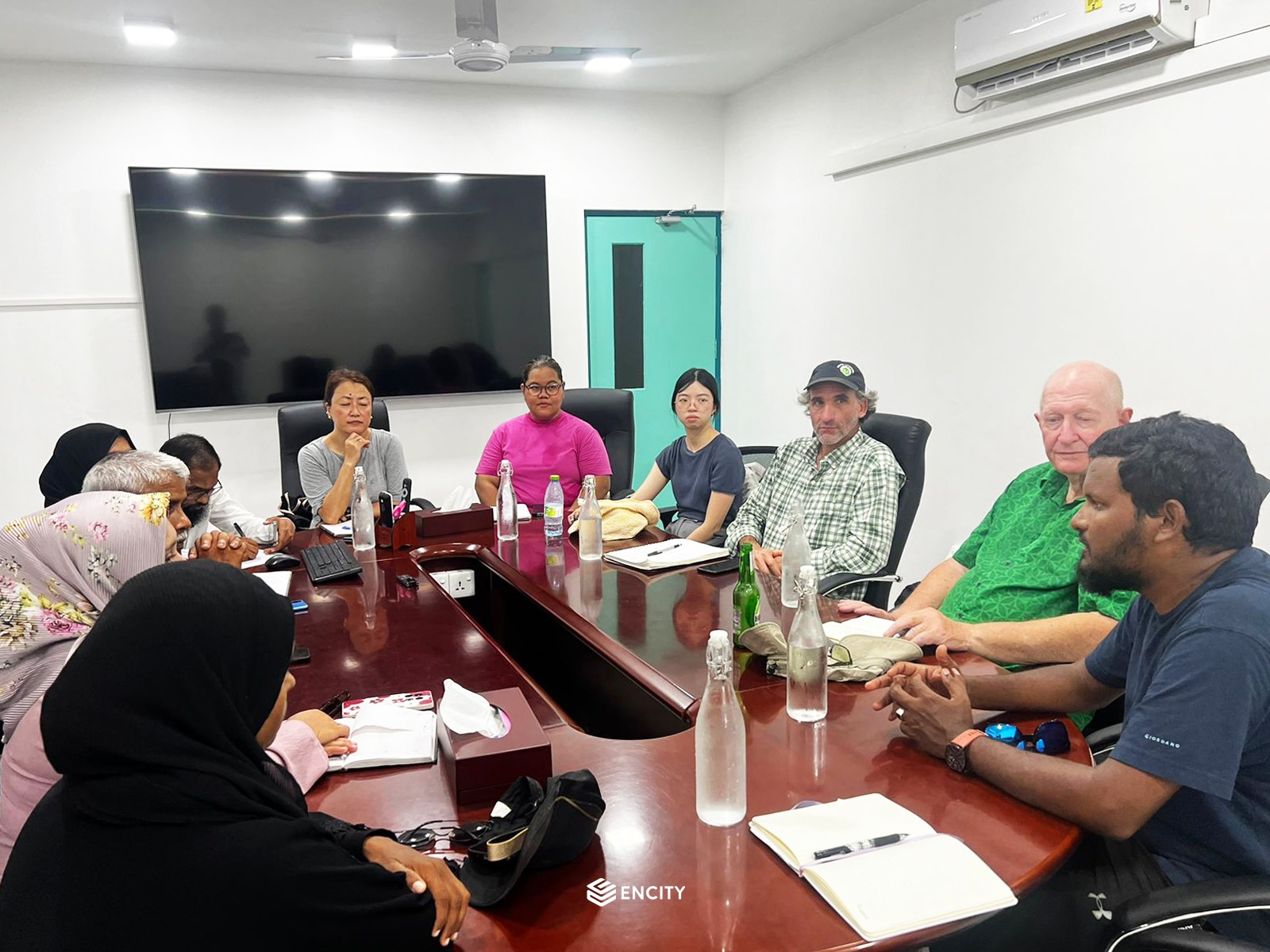
Our methodology centered on radical inclusivity, engaging every level of society to ensure comprehensive transformation. Through rigorous community engagement, we surveyed 278 households and conducted workshops across 6 atolls.
This process brought together diverse stakeholders including government ministries, island councils, international development partners, local farmers, school administrators, community leaders, women’s groups, and youth representatives. Our multi-stakeholder approach ensured that solutions addressed real needs while building broad-based support for implementation.
The solutions
Our six interconnected strategies were designed to work as a comprehensive system:


Figure 3: Illustration of the Farm at Home strategy based on an archetype of local houses. Source: enCity
- Farm at Home revolutionizes household nutrition through space-efficient tower hydroponic systems and dwarf fruit trees, making fresh produce accessible in every backyard.
- Farm as Education transforms schools into agricultural learning centers with greenhouses and orchards, inspiring the next generation while supplying local markets.
- Franchise Farm establishes commercially viable operations combining traditional and hydroponic methods, generating an estimated $1.1 million annually in local production value.
- Farm with Nature introduces agroecological practices that reduce import dependence while building soil health and biodiversity through integrated farming systems.
- Farm to Community creates direct-to-consumer distribution networks with cold storage and delivery services, capturing value for local farmers.
- Farm to Cup establishes healthy food retail outlets with on-site production, providing immediate market access for farmers while meeting growing demand for nutritious options.

Beyond Food Security
This project transcends agriculture, addressing climate adaptation through resilient farming practices, youth engagement through education integration, and economic development through local value creation. Our holistic approach ensures that improving the Maldives’ near-zero agricultural production becomes not just economically viable, but essential for national resilience.
Location: The Maldives
Scale: 298 km2
Client: Asian Development Bank (ADB)
Partner: Agritecture
Service offered: Policy Advisory, R&D

 VI
VI