

Transit-Oriented Development (TOD) represents an integrated planning paradigm that seamlessly weaves together transportation, urban development, economics, environmental sustainability, and social equity. At its heart, the Metro network serves as the backbone, connecting dynamic urban districts that flourish around transit stations, creating vibrant public transportation hubs that breathe life into communities.
In the Ho Chi Minh City Master Plan 2040, collaborating with the Vietnam Institute for Urban and Rural Planning (VIUP), the Southern Institute for Spatial Planning (SISP), and Green Space Co., Ltd., enCity spearheaded a comprehensive Metro planning revision, expanding the network from 220 km to an ambitious 655 km—tripling the original scope to meet 50-60% of residents’ mobility needs by 2060. This visionary network encompasses 12 strategic lines: 8 radial corridors, 2 ring lines, 1 riverside LRT, and 1 dedicated connection to Can Gio.
What drives such bold expansion? Three strategic imperatives shape this urban transformation:
1. TOD: Igniting New Urban Centers
Transfer stations and new TOD nodes outside the city center will form secondary centers, reducing pressure on the urban core, attracting real estate investment, and generating resources for infrastructure reinvestment. The enhanced network boasts 85 strategic transfer stations, integrated through the inner ring Metro Line 6, the outer ring Line 10, and intricate intersections with other critical lines.
An example from Singapore is Buona Vista station—connecting two major MRT lines, serving 23,000 daily commuters while catalyzing the one-north innovation district, now home to 5,000 enterprises. The station precinct has developed into a thriving commercial hub with sustained real estate appreciation and thousands of knowledge-sector jobs.
Figure 1: Transfer stations on the ring Metro lines. Source: enCity & VnExpress
To cultivate TOD nodes in emerging districts, several Metro lines are extended:
- Lines 1, 3, and 9 extend towards Bình Chánh
- Lines 2, 4, and 8 extend to Hóc Môn and Củ Chi
- Lines 5 and 7 extend eastward to Bình Thạnh and Thủ Đức
- Lines 7 and 8 are expanding southward to Bình Chánh and District 7

Figure 2: Strategic TOD station network development across Ho Chi Minh City. Source: enCity
The undeniable success of Singapore’s Tuas West Extension offers a powerful case study. This 7.5 km extension, a SGD 3.5 billion investment, added 4 vital stations, now serving 100,000 workers daily and yielding an astounding 1.2 million labor hours saved annually. Industrial properties in close proximity to the line experienced a robust 10–15% increase in value over five years and are directly connected to the future-forward Tuas Mega Port, projected to handle an immense 65 million TEU per year.
2. Linking HCMC’s vital nodes
Connecting pivotal urban anchors—financial districts, innovation precincts, port facilities, and airport infrastructure—creates seamless metropolitan connectivity, eliminates urban fragmentation, amplifies land values, and accelerates polycentric development patterns.
Key strategies in the revised master plan include:
- Lines 4 and 6 are being strategically aligned to directly connect to Tan Son Nhat Airport
- Line 7 connects the key areas of Tan Kien – Phu My Hung – Thu Thiem – Thanh Da – Truong Tho – and the High-Tech Park
- Line 5’s extension connecting Tam Da with Long Phuoc
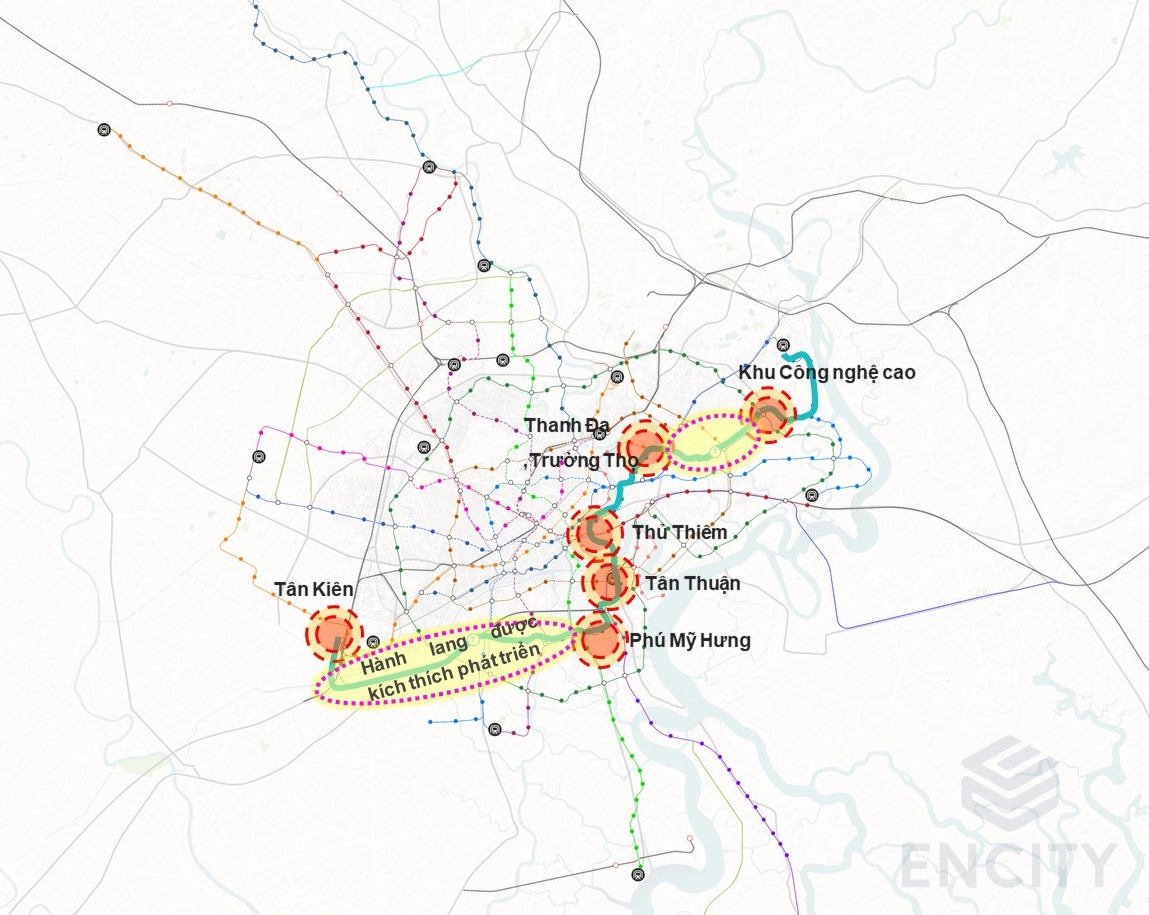
Figure 3: Metro Line 7’s adjustment to connect the city’s premier development anchors. Source: enCity
3. Forging regional connectivity & investment potential
Bridging satellite cities with Ho Chi Minh City’s urban core does far more than expand labor markets—it catalyzes investment flows and orchestrates population distribution across the region.
Consider Metro Line 2’s strategic realignment through Thu Dau Mot, forging a vital artery between Binh Duong and Ho Chi Minh City. This connection unlocks unprecedented TOD opportunities in Hoc Mon and Cu Chi—areas blessed with extensive developable land banks. With passenger capacity reaching 40,000-50,000 per hour per direction, this corridor will substantially alleviate congestion on National Highway 13. Line 6’s branch extension to Di An City further strengthens these regional ties.

Figure 4: Metro Line 2’s strategic realignment enhances regional connectivity while unlocking new development frontiers. Source: enCity
Another strategic proposal is the potential Tan Kien – Thu Thiem national railway line, seamlessly linking the Mekong Delta with high-speed rail infrastructure at Thu Thiem. This creates key TOD nodes at Thu Thiem and Tan Kien stations, primed for commercial and service sector expansion. San Francisco’s Salesforce Transit Center exemplifies such transformative potential: TOD development around this regional hub drove real estate appreciation exceeding 300% over a decade, attracted $7 billion in capital investment, generated thousands of employment opportunities, and boosted public transit ridership by 40%.
The comprehensive adjustments to Ho Chi Minh City’s Metro network transcend mere infrastructure expansion; they represent a strategic imperative to cultivate a highly efficient and dynamic TOD urban environment. By proactively establishing new TOD hubs, enhancing vital regional connections, and seamlessly linking key development nodes, HCMC is poised to evolve into a vibrant polycentric metropolis. This visionary approach will effectively alleviate pressure on the urban core, significantly elevate the quality of life for its citizens, and maximize the efficiency of land utilization. This is the essential trajectory for building a modern, sustainable, and truly livable city for generations to come.
Nen Nguyen
Senior Associate, Transport Planning, enCity Urban Solutions

 VI
VI