

Background
The Midland and Northern Mountainous Region of Vietnam, consisting of 14 provinces, holds significant importance in terms of politics, socio-economy, national defense, and security, serving as the northern gateway and frontier of the country. However, this is one of the most challenging regions and is often referred to as the ‘low-lying area’ and the ‘core of poverty’ of the nation.
The plan leverages the region’s role, advantages, and development opportunities. It also introduces numerous breakthrough solutions to enhance connectivity and pave the way for regional development
Vision
By 2030, the Midland and Northern Mountainous Region will transition to an average to high-income level, with select provinces achieving high-income status.
To achieve a sustainable and inclusive growth visionary, the regional plan focuses on:
- The development of an infrastructure framework connecting the 14-province region with the Red River Delta, capital city Hanoi, and the North Central sub-region;
- The priority of processing, manufacturing, and energy industries;
- Promoting high-value, organic, specialty, sustainable and circular agriculture;
- Enhancing the border economy and tourism;
- Preservation and restoration of forests, with a focus on afforestation and sustainable forestry.
- Efficient use of resources and minerals;
- Ensuring environmental protection, ecological and water security;
- Conservation and promotion of cultural identity of ethnic groups.
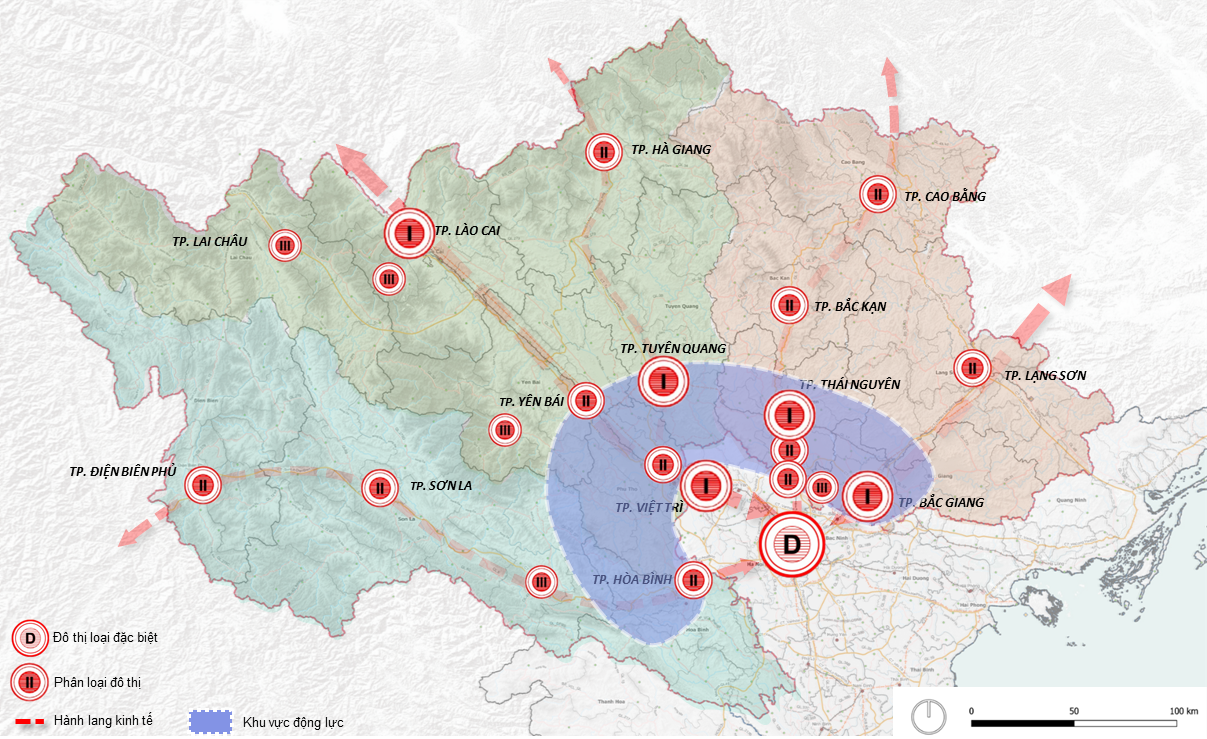 Urban development orientation and spatial organization
Strategies
Enhance regional and international connection: transportation networks connecting the region with the Capital city Hanoi, the Red River Delta, the North Central sub-region, and international development hubs. This will ensure the region’s role as the primary northern entry point for the nation, strengthening ties with China and ASEAN. The development plan includes improving east-west transportation links and establishing new routes connecting to seaports, airports, and major border crossings.
Prioritise five economic corridors, one growth, and a system of growth poles (Thai Nguyen, Bac Giang, Lao Cai, Son La, Lang Son, Phu Tho) along with advantageous economic sectors. The region will establish an industrial-urban-service belt, forming industry clusters, and regional product chains concentrated mainly in Bac Giang, Thai Nguyen, Phu Tho, and Hoa Binh. In addition, efforts will be made to develop specific agricultural and tourism product chains and the border economy.
 Industrial development orientation
Safeguard the ecosystem: the Midland and Northern Mountainous Region is vital for safeguarding water security, maintaining the ecological environment, and protecting biodiversity and headwater forests in the North. Efficient, sustainable use of resources—forest, minerals, land, and water—is crucial and must be prioritized in regional development decisions.
Promote local cultural identity and values: leveraging the region’s cultural diversity and ethnic characteristics. The action plan includes: focusing on enhancing the quality of education and the application of science and technology, improving healthcare services and labor skills; shifting the labor structure to better support economic growth, and preserving the indigenous knowledge of ethnic groups; promoting tourism linked to localethnic groups; building a sustainable urban system that preserves natural landscapes while embracing local distinctive identity.
Partner: Institute of Water Resources Planning (IWRP)

 VI
VI