

Dzung Do Nguyen, co-founder of enCity Urban Solutions and enfarm Agritech, recently appeared on Quest Ventures’ “Questions With” podcast to share his entrepreneurial journey. In this edited conversation, he reflects on how early dreams of meaningful innovation inspired him to transform the urban landscapes of Southeast Asia—and now, the agricultural fields. His expertise in planning, once focused on designing smarter cities, is now helping farmers across the region thrive through AI-powered tools.
Could you tell us about your journey?
Dzung Do Nguyen: When I was a child, two of my heroes were Thomas Edison and Benjamin Franklin. I admired them because they were inventors who, through their life’s work, innovated and created solutions that significantly improved people’s lives, not just in the U.S, but around the world. That was my dream.
Later, while studying at the Hanoi University of Sciences – High School for Gifted Students in Physics, I developed a keen interest in interdisciplinary study. I sought a discipline that could bridge science, the arts, and the social sciences, and planning was the perfect fit. Many people might think planning is just about designing buildings, like an architect’s job. But in the global context, planning is a highly multidisciplinary field. As a planner, I learned a wide range of things. I studied at a liberal arts college in Canada, where I explored urban-themed films and poetry, along with economics and transportation planning. Later, at Georgia Institute of Technology in the U.S., I learned how to perform environmental modeling and use remote sensing and satellite imagery to understand cities and find solutions for them.
It felt natural for someone like me—trained in science, the arts, and social fields—to pursue this path. I enjoy writing, conducting research, and working with technology. One of my passions, which also earned me a Fulbright scholarship to Georgia Institute of Technology, was my concern about climate change and flooding in Ho Chi Minh City. Because of this, I pursued two things: first, I studied hydrology and did extensive computer modeling. Second, I reached out to a top expert in this field, Dr. Ho Long Phi, who is now my partner at enfarm. He’s a hydrologist, an environmental modeling expert, and a soil scientist.
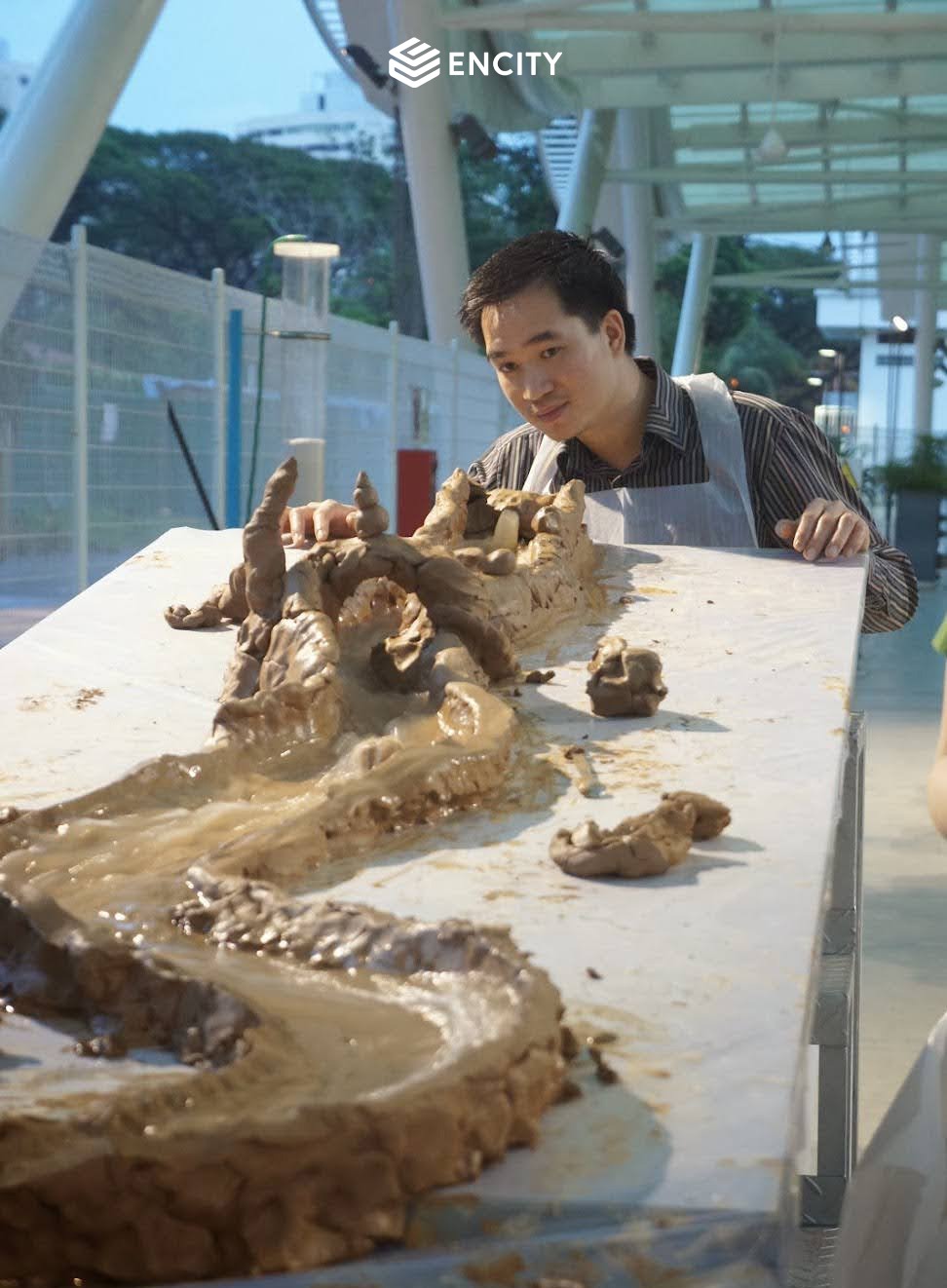
Dzung is studying water flow using a clay model during a workshop at the National University of Singapore
You have worked on significant urban development projects across Vietnam, from Ho Chi Minh City to Dong Nai and Binh Duong. How would you describe the current state of urban planning in Vietnam?
There are two parts to this story. We need to look at the state of our cities, and also at the state of our urban planning practice.
Let me start with the cities. Vietnam is a country where public investment is more equally distributed among sectors, cities, and rural areas. This is a very positive development. The gap between rural and urban areas is relatively small compared to many other Southeast Asian countries. In Indonesia or the Philippines, for example, the difference is huge. While many are impressed by the skyscrapers in Makati, Manila, or Jakarta, their rural areas are often 20 years behind Vietnam. One strength of Vietnam’s approach is its focus on inclusive development.
However, the downside is that our cities are often underinvested because we spread resources thinly. Ho Chi Minh City, for example, retains only about 20% of its tax revenue, with the rest redistributed nationwide. This leads to underinvestment in infrastructure, causing congestion, flooding, and a lack of green space. Many World Bank studies also show that the productivity gap between major cities like Hanoi or Ho Chi Minh City and smaller cities is narrowing. In other words, there’s less incentive for companies to locate in big cities because any productivity gains are offset by congestion and high housing costs.
But there’s also a bright spot. Vietnamese people are highly adaptive, resilient, and flexible. That’s why, even with limited investment, our cities keep moving forward. I pointed out in a recent article in VnExpress that Ho Chi Minh City has the shortest commuting time among all major Southeast Asian cities. People here spend less time traveling to work than in Singapore, despite Singapore’s efficient transport system. Why? Because of motorbikes and the infamous shophouses. These provide flexibility—people can travel door-to-door quickly, take up little road space, and shophouses often serve as both home and workplace. This setup offers a lot to learn from.
On the planning side, our system has been heavily influenced by both the French and Soviet models. First, the French legacy means that planning is still often seen as creating a beautiful city—grand boulevards, opera houses, city halls. That’s what you see in Paris, Hanoi, or Ho Chi Minh City. But in Anglo-Saxon countries, planning is more about making cities efficient, vibrant, safe, livable, and economically competitive. It’s much more than aesthetics. The scope of planning in Vietnam remains quite limited because of that French influence.
The second influence comes from the Soviet era, when there was no market economy and the government did everything. Today, that’s no longer the case. Yet our planning remains rigid, as if the government is writing a recipe for success. But who really builds cities? It’s the ten million people who live in them. Each of us contributes through our daily actions. Planning needs to shift from being descriptive to being flexible—a framework that allows innovation from society, from businesses, developers, and individuals. That’s a positive thing. Planners should act more like conductors, coordinating rather than controlling. Right now, our system is still too rigid and sometimes disconnected from reality.
You recently received the Certificate of Merit from Ho Chi Minh City’s People’s Committee. What does this recognition mean to you?
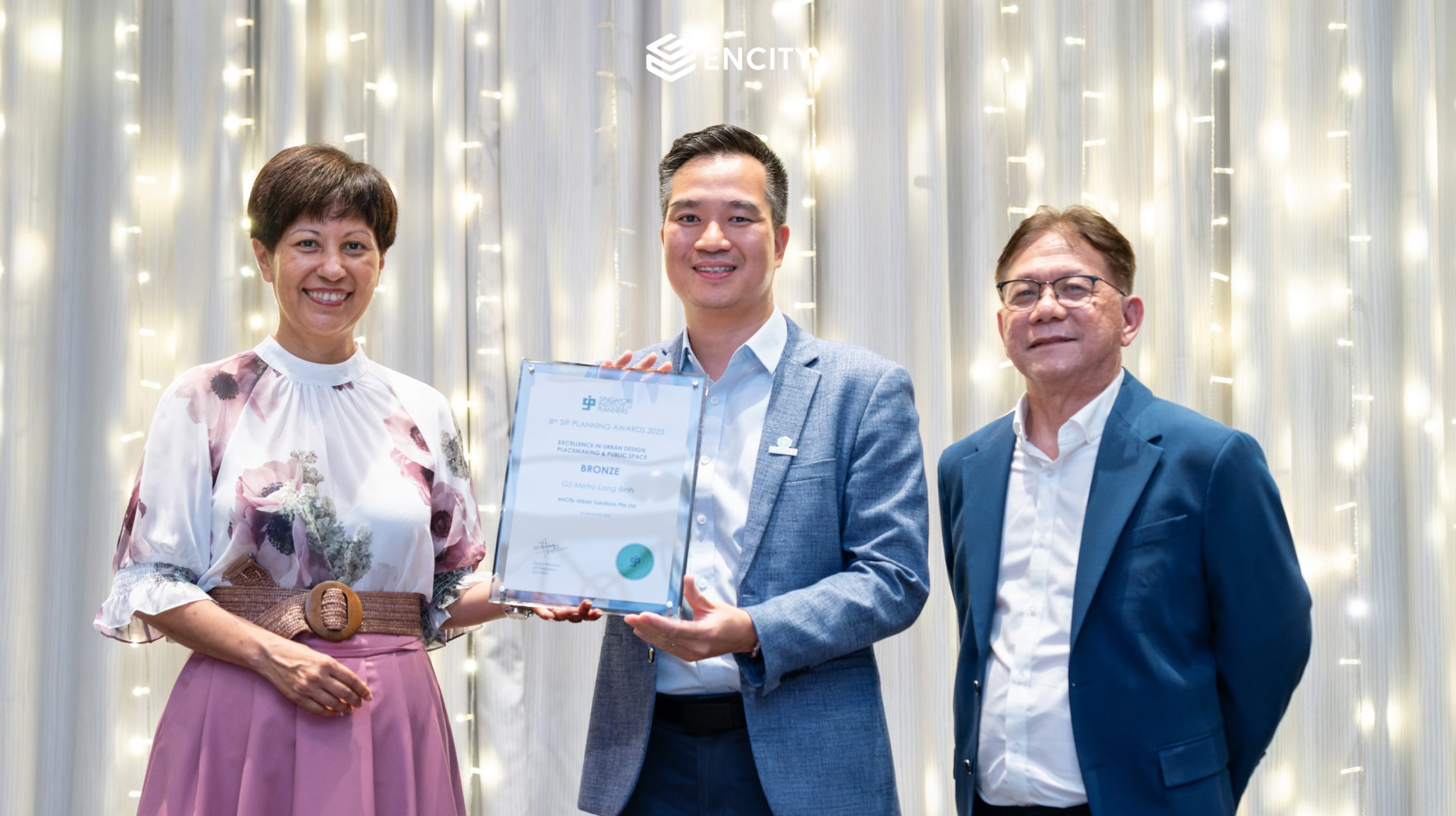
This award means a lot because urban planning is usually a behind-the-scenes job. No one really knows what you did. As my professor once said, no one gets blamed for poor planning that leads to congestion, and no one goes to jail for it. But at the same time, no one gives you credit when the city becomes cleaner, greener, more livable, or more inclusive because of your work.
So this recognition is truly meaningful. I sincerely thank the Ho Chi Minh City government and the city’s Overseas Vietnamese Committee for honoring me as one of the 50 outstanding overseas Vietnamese who have contributed to the city’s development over the past 50 years. Most of the people on the list are scientists or professors, I think, only one or two are from the urban planning field. That makes this acknowledgment even more special. Ho Chi Minh City isn’t my birthplace, but it has been my greatest classroom. I love this city more every day. I hope I’ve been a good student (smile), and I will continue to give back through what I’ve learned here.
What inspired your transition from established urban planning to launching enfarm Agritech?

enfarm didn’t emerge out of nowhere. I’ve always harbored a passion for and concern about climate change and environmental issues. My studies in environmental modeling, and my collaboration with Dr. Ho Long Phi, a leading soil scientist and expert in modeling, laid the foundation.
As a planner and policy advisor to many provinces in Vietnam, I worked with co-ops and spoke directly with farmers to understand their challenges. What I realized is that farming in Vietnam is a risky business, full of uncertainties. A farmer is essentially a business person who has to rent land, buy seeds, grow the crop, and bring it to market. They bear all the risks but lack the know-how or capital resources that companies have to deal with these risks. This is particularly evident in the Mekong Delta and Red River Delta, where many people are leaving farming for factory work. In a factory, you get a stable salary with fewer risks. Farmers often earn less and carry all the uncertainty.
Around 2022, we had already built a tech team in Ho Chi Minh City for smart city solutions. It seemed like a natural transition from urban planning into smart cities. But I realized that with the same know-how, we could create a new tool for farmers to help them overcome uncertainties in the marketplace and climate change. Dr. Phi is a great scientist. We spent a year and a half on R&D. Last year, we launched our high-tech, AI-powered smart soil sensing and monitoring devices. Farmers can now use their phones to understand their soil conditions, crop needs, market prices, and weather. Our AI algorithms provide recommendations. We’re building a virtual assistant for every farmer, helping them navigate uncertainty with better data and decision-making.
Looking at your career trajectory, what’s your life vision?
I’ve always believed that when adults give up their childhood dreams, it’s not because the dream is unrealistic—it’s because adulthood fails them, or they lose inspiration. My dream hasn’t changed since childhood. I want to be an innovator who improves lives through meaningful work. That’s why I admired Benjamin Franklin and Thomas Edison even as a primary school student. They didn’t invent for the sake of invention; they created things that mattered to people. I hope I can do something similar, not necessarily on their scale, but with the same sense of purpose.
Note: This conversation has been edited for clarity and brevity. For the full story of Dzung Do Nguyen’s journey and vision, explore the complete interview on Quest Ventures’ official channels.
Apple Podcast: https://shorturl.at/PzSrJ
Spotify: https://shorturl.at/7JAzz
Website: https://shorturl.at/h6gcz

 VI
VI