

Coastal cities around the world brace themselves as climate change continues to persist. Not only are sea levels rising, flooding has become more frequent along with other natural disasters. As cities look forward, we are tasked with planning for long-term progress that is suitable to local conditions as opposed to imposition of western urbanization for the sake of development. Investments in infrastructure need to cater to economic development as well as sustainability as we progress.
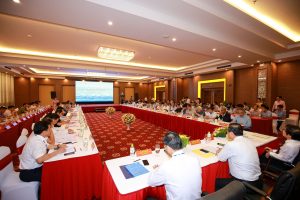
enCity’s CEO + Co-Founder, Dzung Do Nguyen gave a presentation on coastal and riverside urban development at the end of June 2022 by invitation of Quang Nam Province leaders and the Vietnam Urban Development Planning Association. Through analyzing the context of the coastal areas through historical and geographical perspectives, Dzung offered a framework for a development strategy model with four elements as follows: (1) Protection of ecological framework, (2) Development of integrated and multi-functional clusters, (3) Adaptation built on uniqueness, (4) Resilience with multi-purposed infrastructure.

4 elements of the Development Strategy framework
Protection of ecological framework
Assessing how to build and develop urban communities amidst the natural environment continues to be a challenge faced by coastal cities around the world. In Quang Nam for example, previous settlers were able to take advantage of coastal sand dunes, which naturally act as a buffer upon an increase in sea levels, reducing the impact of flooding. Existing communities should leverage on the existing ecological framework. In economic terms, developments adjacent to sand dunes also benefit from great views and vantage points, which increase real estate values.

A look at settlement patterns along coastal regions in Quang Nam that follow sand dune patterns.
Development of integrated and multi-functional cluster

Designing mixed-use clusters that include agriculture and recreation zones, production clusters, innovation hubs and living communities.
Collaborative mixed-use clusters; agriculture and recreation zones, production clusters, innovation hubs and living communities integrated together allow for transition and permeability in the urban fabric, and condenses the production value chain to boost manufacturing. All whilst allowing for adaptation and flexibility which creates a system that can allow for different sizes and uses of buildings as time progresses. Such clusters are able to adapt quickly as technology advances, and, as the market demand shifts, size of parcels that are required can also be adjusted.
Adaptation built on uniqueness
As each locality has its own natural conditions including native flora and fauna, planning should factor in these conditions for optimized development. In North Da Lat for example, mangroves are a native species that due to their environmental characteristics assist to stabilize shorelines while protecting other species in the environment. Incorporating such natural features back into the built urban environment not only enhances the local value of cities but also brings nature back into cities in a sustainable manner, improving quality of life for its inhabitants.
Resilience with multi-purposed infrastructure.
As infrastructure costs are a large investment, planning should capitalize on its benefits at the onset. In Ben Tre for example, our plan allows for built infrastructure to be used in multiple ways. Roads double as dikes, solving not only the issue of transport connectivity, as the rivers are very wide but also assisting in stormwater management and water level increases. Infrastructure can be multi-purposed to cater to local environment and urban requirements.
As Vietnam is a coastal country with more than 3200 kilometers of coastline and more than 1 million kilometers of territorial waters, the urban development of coastal and waterfront areas will be a driving force for socio-economic development, especially in the central provinces of Vietnam. The above proposed framework allows for design to maximize the development potential of local areas, according to their natural conditions.
With award-winning planning projects, projects that have been built and are to be launched soon, enCity is accumulating valuable experience in planning and designing waterfront urban projects which factor ecological and sustainable development.

 VI
VI