

Can Tho, May 17th
In the face of increasing global uncertainty, it has become integral to plan cities and systems that are resilient; which can not only withstand the test of challenges but thrive under all difficult circumstances so that people can flourish.
On 17th May, at the workshop titled “Nature-based Solutions and Science Policy Transfer in the Mekong Delta”, co-chaired by Can Tho University and Ecole Polytechnique Federale de Lausanne (EPFL) – Switzerland, our CEO and Co-Founder, Dzung Do Nguyen shared his insights on Incorporating Nature-based Solutions Concepts into Provincial & City-level Master Planning. At the event, Mr. Dzung proposed a framework with 4 stages: 1) Protection, 2) Integration, 3) Adaptation, and 4) Preparedness for place resilience.
 The four stages of building resilience in urban environments
Protection Against Disruptions: Addressing Climate Challenges
Recent global events, including urban heat islands, natural disasters, and food insecurity, underscore the urgent need to protect cities and citizens with short-term solutions. As sea levels rise due to climate change, the construction and reinforcement of dikes to protect our coasts should be prioritised. Some tailored solutions for flood protection corridors that are worth mentioning include: safeguarding tidal defenses around homes, flood management, and transport infrastructures.
 In Thu Duc City, we incorporated the flood protection corridor as a solution to prevent flooding due to the rise of river water levels
Integrating Diverse Uses into Local Areas – Nature-based Solutions for Communities
In the short to medium term, how we develop and use land is key to protecting our cities in the coming years. This means building smart infrastructures like flood-prevention lakes and parks, buildings incorporated with greenery. Additionally, coastal & waterfront communities can thrive by planning their land use system around water and the changing climate.
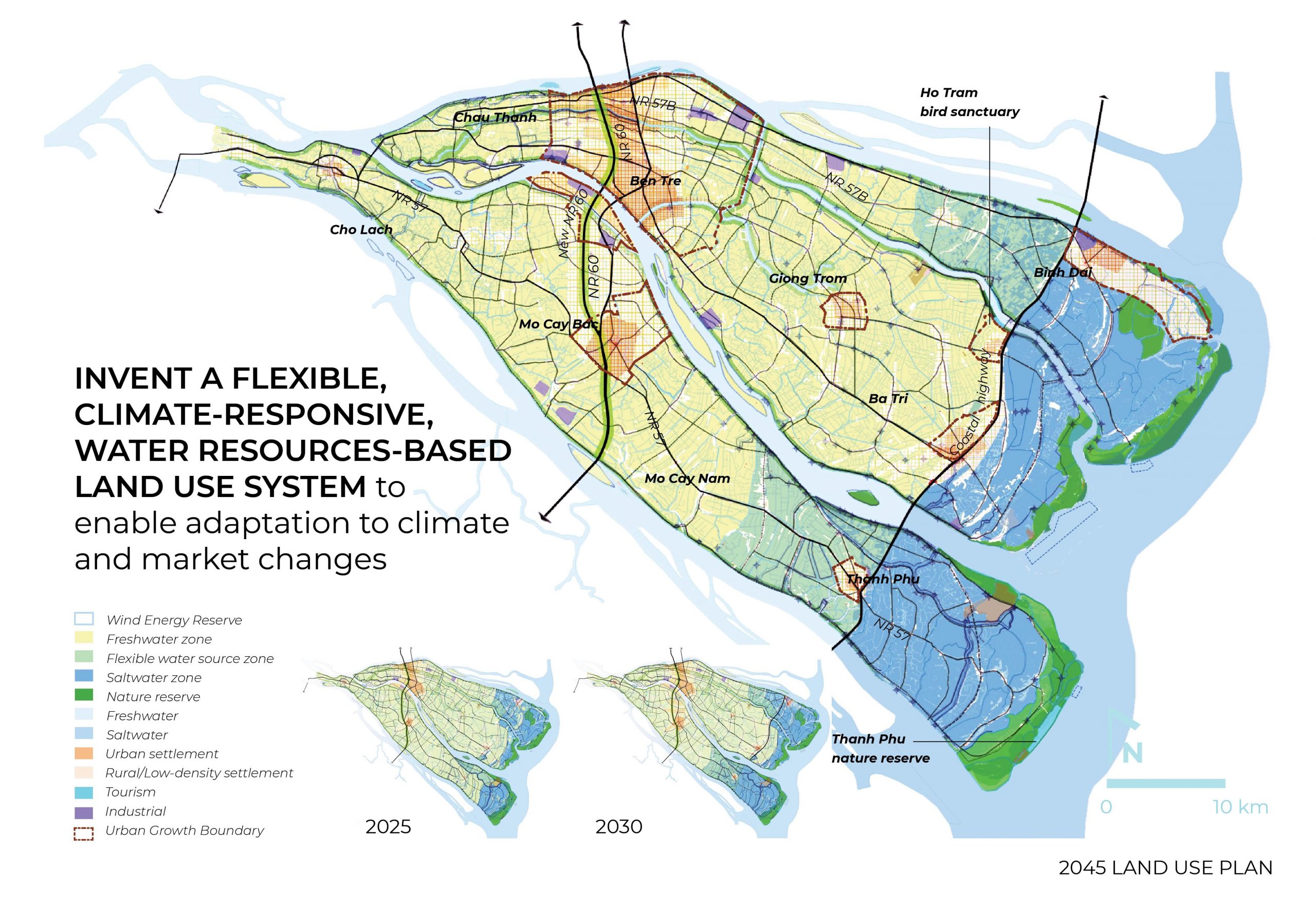 In our project at Ben Tre, a climate-responsive, water resource-based land use system was consolidated
Resilient Adaptation
Our cities need to be flexible to handle a changing environment and unforeseen challenges in the medium to long term. Similar to a precedent like the floating villages in the Netherlands, we might have to adapt to living amidst increasing water levels and constant flooding. Here in Vietnam, a new land use system helps farmers choose crops based on the available water. By planning and designing smart systems, we can help people adjust to new situations.
Preparedness for unforeseen circumstances
In the longer run, we need to be ready for surprises – big storms, emergencies, and evacuation protocol. With a focus on emergency preparedness, we can leverage existing infrastructure to serve multiple purposes, like a highway that doubles as a coastal dike and escape route during floods. This approach ensures that existing base infrastructure can handle the unexpected, helping communities cope and recover better.
 Dzung Do Nguyen sharing his insights on Incorporating Nature-based Solutions Concepts into Provincial & City-level Master Planning; The workshop brought together climate change experts from multiple organisations and universities in Vietnam, Switzerland, Australia, the US, Belgium, and Singapore
Planning and design take center stage during urban development’s integration and adaptation phases since these stages involve crafting medium to long-term strategies that guide the city’s growth. enCity has developed flexible and adaptable strategies to local conditions and needs and is constantly working toward integrating solutions and the latest know-how into our plans, thus allowing us to share valuable lessons that pave the way for a resilient future.

 VI
VI