

One of the most common mistakes in discussions about megacities is to equate “mega” with population size. A city does not become effective simply because it gets bigger. It only becomes powerful when scale is converted into productivity: more job opportunities, better labor matching, faster knowledge spillovers, and urban services that function efficiently at scale. As Alain Bertaud argues, the core economic reason large cities exist is their ability to sustain a large, integrated labor market in which people across different locations can still access employment within a reasonable amount of time. Once that labor market is fragmented by distance, congestion, or inefficient spatial form, the economic foundation of the megacity begins to weaken.
From that perspective, the key question is no longer whether a city should be monocentric or polycentric. The real question is: what kind of structure reduces the cost of accessing jobs, preserves agglomeration benefits, and prevents scale from turning into friction? Bertaud is careful not to suggest that there is one ideal urban form for every place or every stage of development. But he does show that fragmented, discontinuous, and overly dispersed urban expansion is usually more costly to operate. By contrast, cities with relatively continuous development, sufficient density, and a coherent spatial structure tend to be more compatible with public transport, shorter trips, and lower transport-related emissions. He also reminds us that planners ultimately have only three major levers to shape urban form: land-use regulation, infrastructure investment, and taxes or fees.
This is why Tokyo is so often cited as one of Asia’s clearest examples of a successful megacity structure. Its strength lies not simply in its size, but in its ability to develop a network of real subcenters such as Shinjuku, Shibuya, and Ikebukuro, each anchored by major railway nodes within a continuous urban fabric. In other words, Tokyo did not respond to growth pressure by simply pushing people outward into disconnected settlements. It created multiple strong centers of employment, commerce, culture, and mobility, all functioning within one integrated labor market. This is polycentricity at its best: multiple centers, but not fragmentation. Japanese experience also offers another important lesson: rigid green belt thinking has gradually given way to more flexible spatial strategies that avoid freezing development in ways that increase long-distance commuting and inefficient leapfrog growth.
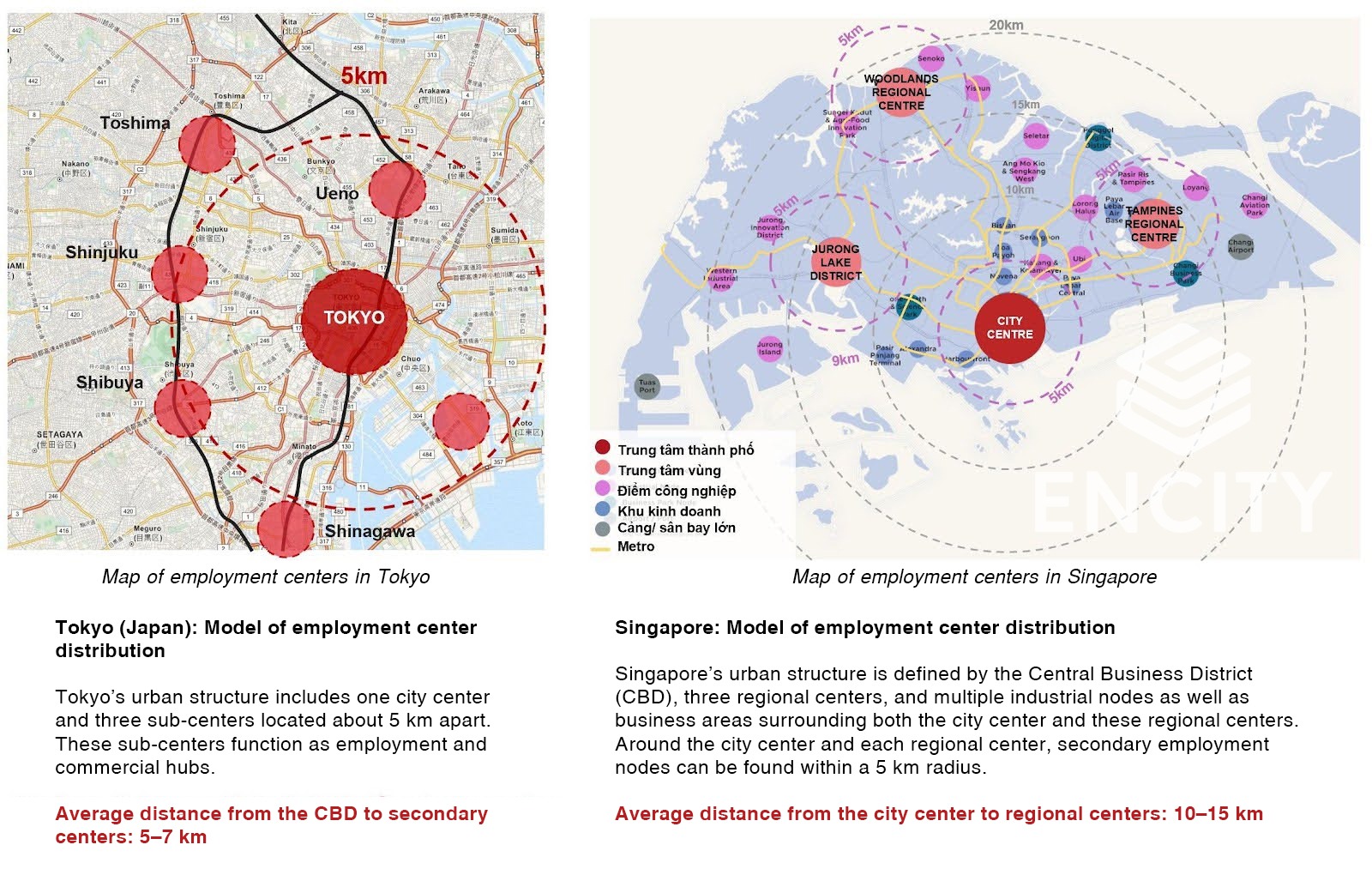
Seoul followed a similar logic, but with a more explicit planning framework. Research on Seoul often points to its restructuring around several metropolitan and regional centers, and more recently to the idea of “30-minute locality infrastructure” — a way of organizing urban space so that key daily functions can be reached in a relatively short time. The deeper lesson from Seoul is not that every city should replicate the same number of centers. It is that decentralization works only when it disperses functions without fragmenting the labor market. New centers must not be just residential concentrations. They need to become mixed-use urban nodes with jobs, services, commerce, and strong public transport so that people can live more of their daily lives locally, without losing access to the wider metropolitan economy.
This is precisely where many satellite city strategies around the world have struggled. Bertaud has long been skeptical of the idea that large metropolitan regions can be efficiently structured as a collection of self-contained “urban villages.” In practice, there is little evidence that this model works at scale. The experience of new towns around Seoul and Shanghai shows why: many residents still commute back into the main city for work, while a significant share of jobs in the new settlements is filled by commuters coming from elsewhere. In other words, building a new town does not automatically create a new center. Without real employment concentration, quality services, and strong connectivity, satellite development often becomes simply a more distant place to live, not a more complete place to live.
A fourth lesson comes from green structure. For decades, the green belt was treated as the classic instrument for containing urban sprawl. But Asian realities suggest that a rigid, closed green belt is not always the most effective solution. In peri-urban landscapes where villages, farmland, logistics, infrastructure, waterways, and urban clusters are deeply intertwined, a fixed ring can generate leapfrog development, longer commutes, and conflict with real land-use dynamics. This is why many contemporary strategies are moving toward a more open green structure based on green wedges, river corridors, flood retention areas, and ecological buffers rather than a single hard boundary. The critical point is that successful green space is not simply land that remains unbuilt. It is an ecological network with clear environmental functions, integrated into the logic of urban development itself.
Finally, successful megacities are not shaped by spatial ideas alone. They also rely on implementation tools. This is where Taipei becomes particularly interesting. As highlighted in several planning studies, Taipei has combined transit-oriented development, land value capture, and transferable development rights to guide growth around transit nodes while shifting development rights away from environmentally sensitive areas, flood corridors, and heritage zones toward places that can absorb higher density. What matters here is not only the technical instrument, but the planning philosophy behind it: urban structure cannot rely on zoning maps alone. It needs mechanisms that reallocate development rights and align private incentives with public spatial goals.
If there is one takeaway from these international cases, it is this: a successful megacity is not one that expands endlessly, nor one that compresses everything into a single dominant core. It is a city that turns scale into productivity through an integrated labor market, a network of strong and well-connected centers, a transport system aligned with urban form, a flexible and functional green structure, and implementation tools capable of turning planning into reality. The future of megacities, in other words, is not about becoming bigger. It is about being organized more intelligently.
Dzung Do Nguyen
enCity Senior Principal, Planning + Urban Design

 VI
VI